

Views: 0 Author: Site Editor Publish Time: 2026-08-14 Origin: Site


Modern automotive clear coats demand faster correction times. High-volume shops need high-speed polishing capabilities to stay profitable. Increased Orbits Per Minute (OPM) accelerate defect removal on scratch-resistant and high-solid clear coats. However, poorly engineered high-speed machines introduce severe operational risks. You face excessive vibration, operator fatigue, premature bearing failure, and unpredictable heat generation on delicate panels. Selecting the right machine requires looking past raw motor wattage. You must evaluate internal balancing, trigger control, stage-specific speed versatility, and sustained torque under load. Whether you are outfitting a multi-bay detailing studio, training seasonal staff, or sourcing a fleet, the mechanical integrity of the tool dictates the finish quality. A true high speed dual action polisher delivers aggressive cutting power without compromising operator control or paint safety.
Torque Over Unloaded Speed: A true professional DA polisher maintains pad rotation under pressure; high free-spinning OPM is useless if the machine stalls on curved panels.
Speed Versatility is a Necessity: A high-speed machine must still operate flawlessly at lower speeds for jeweling and ceramic coating prep on "like new" paint.
Trigger Precision is Critical: Variable speed dials must be paired with progressive triggers to allow safe pad priming and controlled edge work without slinging compound.
Ergonomics Dictate Output: High-speed correction amplifies vibration; machines lacking CNC-machined counterweights will severely limit an operator's daily working hours.
Sourcing Requires Due Diligence: When buying at scale, evaluating the internal components (bearings, gear machining) of an OEM dual action polisher is more critical than exterior branding or highly edited promotional videos.
The goal of high-speed polishing is to maximize the cut rate without crossing the threshold into clear coat burning or inducing micro-marring. Success is measured by consistent paint correction speed, minimal operator fatigue, and zero machine-induced defects across varying staff skill levels. Operators need a tool that behaves predictably. When a machine operates at 5,000 OPM or higher, any imbalance in the backing plate or internal gearing translates directly to the paint surface. This imbalance causes the pad to skip, bounce, or create pigtail scratches that require heavy compounding to remove.
Higher speeds generate exponential friction. The physics of high-speed dual-action movement dictate that energy not used for cutting is converted into heat. The machine's backing plate design and internal ventilation system must actively dissipate this heat away from the polishing pad. If heat builds up in the foam or microfiber pad, the hook-and-loop adhesive backing will fail. In worst-case scenarios, the clear coat can swell and strike through, requiring a panel respray. Effective heat management separates capable machines from those that merely spin fast.
Entry-level consumer polishers often rely on high RPM but lack the torque and internal balance required for sustained correction. They bog down immediately when pressure is applied. Professional-grade units utilize precision gear reduction, advanced motor windings, and calibrated counterweights to sustain safe power. These engineering upgrades ensure the machine maintains its orbit and rotation even when the operator leans into a heavy compounding phase on a heavily oxidized hood. You need a machine that pushes through resistance rather than surrendering to it.
Paint correction requires leveling the clear coat to the depth of the deepest defect. Doing this quickly means generating significant mechanical energy. A machine that vibrates excessively forces the operator to loosen their grip, which changes the pad angle. A flat pad is mandatory for dual-action polishing. Any deviation from a perfectly flat pad concentrates the heat and abrasives onto a small sliver of the pad face, drastically increasing the risk of burning edges. Precision engineering keeps the pad flat, the operator comfortable, and the cut rate consistent.
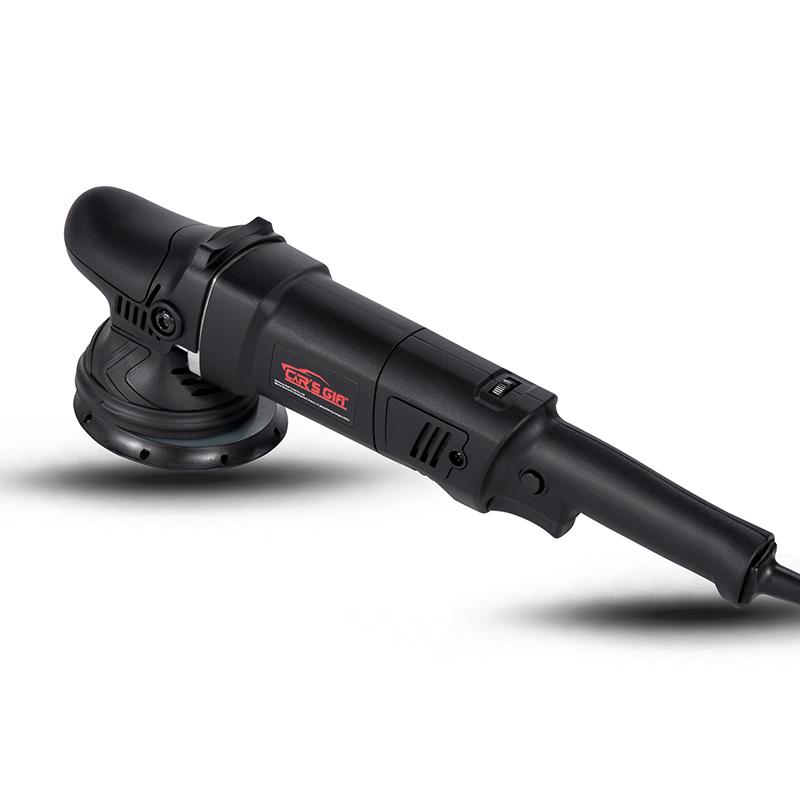
The orbit diameter, or throw, dictates how far the pad travels off its center axis. A 15mm dual action polisher is widely considered the industry standard for high-speed correction. It offers a superior balance of cutting power and contour adaptability. An 8mm throw is often too slow for heavy defect removal on large panels, requiring excessive passes to achieve the desired cut. Conversely, a 21mm throw provides massive cutting power on flat surfaces but is highly prone to stalling on complex curves and concave body lines.
The 15mm orbit allows detailers to navigate modern vehicle geometries. Today's vehicles feature sharp body creases, intricate bumper designs, and narrow A-pillars. A 15mm machine paired with a 5-inch backing plate fits these contours without losing pad rotation. This versatility means an operator can complete an entire vehicle using a single machine, switching only pad sizes or compounds rather than swapping tools entirely. It streamlines the workflow and reduces equipment clutter on the shop floor.
Marketing materials frequently highlight peak wattage, but detailers must differentiate between theoretical power and actual sustained torque. High free-spinning OPM looks impressive on paper, but it is useless if the machine stalls when contacting the paint. You must test if the machine maintains pad rotation when downward pressure is applied in real-time conditions.
A capable machine features a motor wound with high-purity copper and a gear system designed to multiply torque. When the pad encounters friction, the motor must push through the resistance rather than bogging down. This sustained torque ensures the abrasives in the compound break down evenly, delivering a consistent finish and preventing holograms. Heat soak is another factor. A motor running at maximum capacity will overheat during an 8-hour shift. High-quality copper windings handle the electrical load efficiently, keeping the motor housing cool and extending the tool's lifespan.
The internal components bear the brunt of high-speed oscillation. High-grade sealed bearings are an absolute necessity. Unsealed or low-quality bearings will quickly succumb to the fine clear coat dust and dried compound generated during correction. Once dust breaches the bearing seal, it acts as an abrasive, leading to catastrophic failure or severe grinding noises.
Smooth oscillation during heavy compounding relies on precision-cut gears. Machined steel gears transfer power efficiently and reduce the mechanical chatter that often plagues cheaper units. When evaluating a machine, listen to the gear housing under load. A smooth, consistent whine indicates proper meshing and high-quality lubrication. A rattling or clanking sound signals loose tolerances that will eventually shear the gear teeth.
Throw Size Application Comparison
Orbit Diameter | Primary Detailing Application | Contour Adaptability | Stall Resistance on Curves |
|---|---|---|---|
8mm to 12mm | Sanding mark removal, tight spaces, A-pillars | Excellent | High |
15mm | Standard paint correction, one-step polishing | Very Good | Moderate to High |
21mm | Large flat panels, heavy compounding on trucks/SUVs | Poor | Low |
Treat the variable speed dial like a gear shift for different paint conditions. A machine must offer distinct, tactile speed steps, typically ranging from 1 to 6. However, a dial alone is insufficient without an electronic speed control module. This internal component uses sensors to monitor the armature's rotation. When resistance increases during heavy cutting, the module automatically feeds more current to the motor, preventing RPM drop-off.
This stabilization is equally important at the lower end of the spectrum. A high-speed machine must maintain stable, low-end RPMs for finishing and jeweling. If the speed fluctuates at setting 2 or 3, achieving a flawless, mirror-like finish on soft black paint becomes incredibly frustrating. Consistent speed ensures the pad glides evenly, refining the clear coat without introducing new micro-marring. You need a machine that holds its RPM exactly where you set it, regardless of the pressure applied.
Operational control requires more than a static speed dial. A soft switch DA polisher features a progressive trigger that allows detailers to feather the speed from a dead stop. This mechanical advantage is a daily operational necessity. It enables the operator to prime pads and spread polish evenly across the working area without slinging compound onto adjacent panels, glass, or plastic trim.
Furthermore, a progressive trigger allows detailers to safely navigate tight edges. By slightly releasing the trigger, the operator can drop the RPMs momentarily while passing over a sharp body line, then squeeze back to full power once the pad returns to a flat surface. This dynamic control reduces the risk of burning edges and eliminates the need to constantly adjust the top-mounted speed dial during a single pass. It keeps both hands firmly on the machine, maximizing safety and efficiency.
Prolonged exposure to high-frequency vibration causes Hand-Arm Vibration Syndrome (HAVS) and immediate operator fatigue. Fatigued operators compromise their technique. They apply uneven pressure or tilt the pad, which leads to sloppy results and potential paint damage. Mitigating this requires a meticulously engineered internal counterweight system.
An ergonomic dual action polisher utilizes CNC-machined counterweights matched to the exact weight of the backing plate and standard polishing pads. If the counterweight is off by even a few grams, the machine will attempt to walk or skip across the paint. Proper balancing ensures the tool glides smoothly. The operator should only need to guide the machine, not wrestle it into submission. A perfectly balanced machine feels like it is hovering over the paint, allowing for one-handed operation during light finishing stages.
The physical touchpoints on the machine dictate comfort during long correction sessions. Assess the rubberized over-molding on the head and rear handle. The grip geometry should accommodate various hand sizes and allow for multiple hand positions. Some operators prefer gripping the head directly, while others hold the side handle or the neck of the machine.
Heat dissipation at the grip is a critical safety and comfort factor. The front grip sits directly above the gear housing, where friction is highest. A well-designed machine incorporates cooling vents that draw air through the tail, pass it over the motor, and exhaust it through the gear head. This airflow directs heat away from the operator's hands. The front grip must remain cool to the touch even after 45 minutes of continuous high-speed correction. If the head gets too hot to hold, the operator will shift their grip, compromising pad flatness.
For detailing franchises or tool brands looking to scale, selecting a DA polisher manufacturer requires rigorous auditing. You must look beyond the spec sheet and evaluate their ISO certifications, motor winding processes, and assembly line QA protocols. A manufacturer's ability to deliver consistent quality across a batch of 500 units is vastly different from producing a single golden sample.
Inspect their quality control checkpoints. Do they test armatures for dynamic balance? Do they run the assembled machines under load to verify the electronic speed control modules function correctly? Reliable factories maintain strict tolerances for runout and vibration, ensuring every unit off the line performs identically. You should request documentation on their bearing sourcing and grease specifications, as these small details dictate the machine's lifespan in a commercial environment.
When exploring an OEM dual action polisher, buyers must weigh the trade-offs between off-the-shelf white labeling and custom tooling. Custom tooling allows for proprietary grip designs and specific counterweight calibrations, but it requires higher upfront investment. Key evaluation points include warranty defect rates, the availability of replacement wear parts like carbon brushes, backing plate compatibility, and minimum order quantities.
Avoid manufacturers that rely on fast-motion or slow-motion promotional videos to sell their tools. Demand real-time, unedited stress test footage. Request videos showing the machine operating under heavy load on a curved panel to verify it does not stall. Transparency in testing is the strongest indicator of a reliable manufacturing partner. You need a supplier who understands the daily abuse these tools take in a high-volume detailing bay.
High speeds can cause the pad to stop rotating and only vibrate when hitting concave curves. This halts the cutting process entirely, turning a dual-action machine into a mere orbital sander. Stalling typically occurs when the foam pad binds against the curvature of the panel, creating more friction than the motor's torque can overcome. A professional DA polisher minimizes this, but technique remains a factor.
Train operators on proper technique to mitigate this. Operators must learn to lift pressure slightly on edges and curves to maintain rotation. Additionally, some machine designs benefit from the washer mod. This involves installing a thin spacer between the backing plate and the spindle to prevent the plate from rubbing against the rubber anti-spin shroud during heavy deflection. This simple modification frees up the rotation and keeps the pad spinning on tight curves.
While dual-action polishers are inherently safer than rotary buffers, high-speed DA polishers can still burn paint on plastic bumpers or sharp body lines if kept stationary. Plastic substrates do not dissipate heat like aluminum or steel. The heat stays localized, rapidly softening the clear coat until it twists and tears off the panel.
Establish strict standard operating procedures for arm speed. Operators must keep the machine moving at a consistent pace, typically one inch per second. Implement frequent pad blow-outs with compressed air to remove spent compound and cool the foam. Utilizing infrared temperature guns during heavy compounding stages helps train new staff to recognize safe operating temperatures. If the panel is too hot to touch with the back of your hand, you must stop and let it cool.
High-speed machines can amplify poor technique, especially for seasonal or newly trained staff. Tilting the machine to dig into a scratch concentrates all the mechanical energy onto a tiny surface area. This leads to rapid edge burn-through or severe buffer trails that require hours of refinement to fix.
Mandate training on keeping the pad perfectly flat against the panel. Operators should utilize the machine's lower speed settings to safely learn panel contours and machine behavior before engaging maximum OPM. Building muscle memory at speed setting 3 ensures that when the operator ramps up to speed 6, their technique remains flawless and safe. Mark a straight line on the backing plate with a marker so operators can visually verify pad rotation at all times.
Request a physical demo unit to verify the machine's balance, grip ergonomics, and vibration levels during a 30-minute continuous run.
Conduct a real-time stress test on a scrap panel using heavy compounding pads and 15 pounds of downward pressure to evaluate stall resistance.
Verify the effectiveness of the electronic speed control module by monitoring RPM consistency at both the lowest and highest dial settings under load.
Audit the manufacturer's QA data, specifically requesting dynamic balancing reports and bearing sourcing documentation.
Check the availability, lead times, and cost of replacement carbon brushes, backing plates, and power cords to ensure long-term serviceability.
A: Always prime the pad and spread the product at the lowest speed setting to ensure even coverage and prevent compound sling. Once the abrasive is spread evenly across the working section, ramp up to higher speeds for the correction phase.
A: For newer paint in good condition, heavy high-speed cutting is unnecessary. Use a medium-to-low speed setting with a finishing polish and soft foam pad to jewel the paint and remove minor wash marring without removing excess clear coat.
A: A 15mm throw offers the best balance for modern vehicles. It provides aggressive defect removal on flat panels while maintaining pad rotation on curved surfaces, narrow A-pillars, and complex bumpers where a 21mm throw would frequently stall.
A: A soft switch features a progressive trigger that allows the user to control the machine's RPM based on how far the trigger is pulled. This offers precise control for edge work and product spreading before locking in the maximum dial speed.
A: Prevent pad stalling by keeping the pad perfectly flat against the surface. Reduce downward pressure when navigating complex curves, concave panels, or sharp body lines to allow the motor to maintain rotation against the increased friction.
A: Blow out your pad with compressed air or use a pad conditioning brush after every single section pass. This removes spent abrasives, clears away removed clear coat dust, and significantly reduces heat buildup in the foam or microfiber.


