

Views: 0 Author: Site Editor Publish Time: 2026-08-21 Origin: Site


Paint correction efficiency relies heavily on mechanical stroke, with the detailing industry increasingly shifting from standard-throw to long-throw orbital machines to reduce labor hours. Selecting the wrong orbit size directly impacts profitability and finish quality. A throw that is too large causes pad stalling on complex curves, while a throw that is too small results in excessive time spent on large, flat panels. Evaluating an 8mm vs 15mm dual action polisher requires analyzing panel geometry, cutting power requirements, operator fatigue, and whether a single-tool or multi-tool approach best fits the operational workflow. You must match the machine's mechanical capabilities to the specific clear coat conditions you face daily. Understanding these differences ensures you equip your shop with the right tool for the job, maximizing throughput without sacrificing the final finish.
Cutting Efficiency: A 15mm DA polisher generates a larger footprint per revolution, significantly reducing correction time on medium-to-large surfaces—potentially delivering up to twice the cutting power of an 8mm unit under optimal conditions.
Curve Management: An 8mm DA polisher maintains pad rotation more consistently on concave surfaces and complex body lines, minimizing the risk of pad stall.
Tool Ecosystem: Professional workflows often require configuring a 3 inch 5 inch dual action polisher setup to handle both bulk correction and intricate detail work efficiently.
Operator Experience: While 15mm throws cut faster, they demand stricter technique to keep the pad flat; 8mm throws are generally more forgiving, highly stable, and produce less lateral vibration.
The term "throw" refers to the orbit diameter of the machine. It measures the exact distance the backing plate travels off-center during a single complete revolution. If you mark the center of the spindle and measure the maximum outward travel of the backing plate, an 8mm machine moves 8 millimeters side-to-side. A 15mm machine nearly doubles that lateral movement. This mechanical measurement dictates how much surface area the polishing pad covers during operation. A wider orbit means the abrasives travel further across the paint per revolution. This fundamental difference in geometry dictates how each machine interacts with automotive clear coat and how quickly it levels defects.
A standard dual action polisher operates using two distinct motions simultaneously. The motor drives a forced oscillation, moving the backing plate in an orbital pattern. Concurrently, the backing plate spins freely on a bearing assembly. This free-spinning rotation is driven by centrifugal force and momentum, not direct mechanical gearing. The combination of these two movements creates the necessary friction and heat to level clear coat and remove scratches. It also prevents the concentrated heat buildup that often causes holograms or burn-through with traditional rotary buffers. The dual movement disperses the energy over a wider area, keeping panel temperatures manageable.
Kinetic energy transfer directly correlates to cutting capability. A larger throw increases the velocity of the pad's outer edge. When the pad travels 15mm per orbit instead of 8mm, it generates significantly more friction against the paint surface at the exact same RPM. This increased friction translates to higher kinetic energy. Higher kinetic energy allows the abrasives in the polishing compound to break down faster and level deep scratches more efficiently. You get faster defect removal because the machine is doing more physical work per second. Consequently, long-throw machines remove heavy defects in fewer passes than standard-throw machines.
Throw size heavily influences the required motor specifications. Pushing a pad through a 15mm orbit requires substantial torque to overcome surface friction. If the motor lacks torque, the pad bogs down when it encounters sticky paint or curved panels. Therefore, 15mm machines typically feature higher-wattage motors, often ranging from 700W to 1000W. These robust motors sustain the larger orbit without losing RPM under pressure. Conversely, an 8mm unit generally operates effectively on lower power, typically between 500W and 700W. The shorter stroke encounters less rotational resistance, allowing a smaller motor to maintain consistent pad rotation. Matching motor wattage to orbit size prevents overheating internal components during heavy correction sessions.
The mechanical advantage of a shorter stroke lies in rotational consistency. An 8mm DA polisher keeps the pad's center of gravity closer to the spindle. This tight orbit reduces lateral movement. Reduced lateral movement means the machine fights you less during operation. The pad stays planted firmly on the surface, delivering a smooth, predictable polishing experience. This tight stroke is exceptionally efficient for refining paint to a high gloss. The micro-abrasives are worked evenly over a concentrated area, making it the preferred choice for the final jeweling stage on soft, finicky clear coats.
For operators learning to polish vehicles, stability is the most important factor. The smaller throw translates directly to easier control. It generates significantly less vibration through the handle and body of the tool. Users do not need to fight the machine's momentum to keep it on the desired path. This forgiving nature provides a safer learning curve. Novices can focus on mastering arm speed, downward pressure, and pad priming without wrestling a highly aggressive tool. The 8mm throw minimizes the risk of introducing pigtails or marring the paint due to poor handling technique or uneven pressure.
Pad stall occurs when the free-spinning rotation of the backing plate stops, leaving only the orbital jiggling motion. This drastically reduces cutting power and leaves behind uncorrected defects. An 8mm throw is highly resistant to stalling on curved, convex, or concave body panels. Because the orbit is tight, the pad edges do not experience extreme variations in surface pressure when navigating contours. The machine maintains its rotational speed even when tilted slightly to follow complex body lines. This makes it the superior choice for modern vehicles featuring aggressive aerodynamic styling, sharp body lines, and intricate panel shapes.
Standard-throw machines offer excellent versatility regarding pad sizes. Many detailers utilize a 3 inch 5 inch dual action polisher setup on an 8mm chassis. Swapping between a 5-inch plate for standard panels and a 3-inch plate for tight spaces is mechanically safe on an 8mm machine. The lower rotational mass prevents the severe vibration issues that occur when downsizing plates on long-throw polishers. This configuration allows operators to easily polish A-pillars, intricate bumpers, mirror caps, and even motorcycles using a single power tool without destroying the internal bearings.
The primary drawback of the 8mm throw is slower defect removal on large panels. When correcting expansive hoods, roofs, or truck beds, the smaller footprint requires more passes to achieve the desired result. The abrasive compound is worked over a smaller area per oscillation. This limitation leads to increased labor time for full-vehicle corrections. For professional shops dealing with high volumes of heavily swirled vehicles, relying solely on an 8mm machine creates a massive bottleneck in the production workflow.
To maximize the efficiency of an 8mm machine and prevent unnecessary delays, follow these operational steps:
Prime the pad completely with compound to ensure uniform abrasive distribution across the entire foam face.
Use a slower arm speed (approximately 1 inch per second) to compensate for the smaller mechanical throw.
Apply moderate downward pressure to engage the foam structure and force the abrasives into the clear coat.
Clean the pad with compressed air after every single panel to prevent clear coat residue from clogging the pores.
Swap to a fresh pad after every three panels to maintain maximum cutting friction.
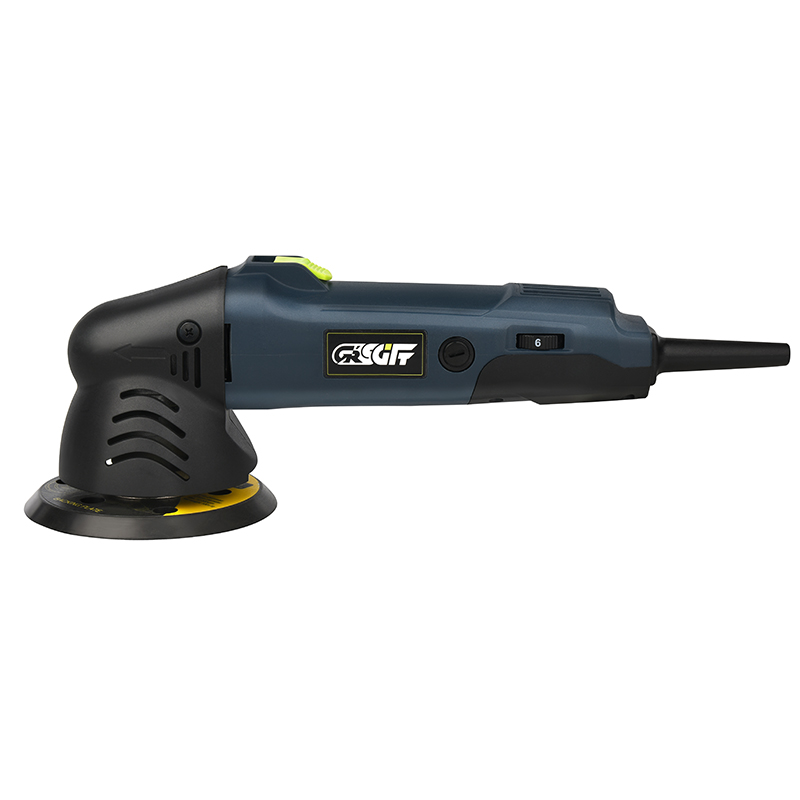
A 15mm DA polisher is engineered for rapid defect removal. The 15mm orbit covers substantially more surface area per oscillation compared to standard machines. This wider path effectively increases the cut rate for heavy swirl removal. The machine does the heavy lifting, meaning operators do not need to apply aggressive downward pressure to force the abrasives into the paint. The sheer kinetic energy of the long throw breaks down the clear coat defects quickly, leveling the surface in a fraction of the time required by shorter-throw polishers. It is a brute-force tool designed for speed.
Maximizing the cutting power of a 15mm machine requires specific technique adjustments. Standard-throw machines often require moderate downward pressure and moderate arm speed. In contrast, a 15mm throw performs best with very light downward pressure. You simply guide the machine and let the weight of the tool do the work. Pushing down hard actually stalls the rotation and generates excessive, dangerous heat. Additionally, arm speed must be reduced. Moving the machine too quickly across the panel prevents the wide orbit from fully breaking down the abrasives. Slow, deliberate passes with minimal pressure yield the fastest and cleanest correction results.
The 15mm throw excels in specific operational environments. It is the optimal tool for high-volume production detailing where time is directly tied to revenue. It is highly effective on large trucks, SUVs, and expansive flat panels. When dealing with hard clear coats commonly found on German luxury vehicles, the aggressive cut of the 15mm orbit easily levels deep scratches that would take hours to remove with an 8mm tool. Any scenario requiring heavy compounding over large, relatively flat surface areas is the ideal use case for this machine. It turns a two-day correction job into a one-day job.
The aggressive nature of the 15mm throw demands strict adherence to proper technique. The most critical requirement is keeping the pad perfectly flat against the paint surface. Tilting a 15mm machine significantly increases the risk of pad stall. When the wide orbit encounters uneven pressure on the pad edge, the rotational momentum stops immediately. Furthermore, tilting the pad concentrates the high kinetic energy onto a small edge, which can quickly generate excessive heat and potentially burn through the clear coat on plastic bumpers or sharp body lines. Precision handling is mandatory to avoid costly damage.
Professionals often utilize technical modifications to maximize the efficiency of long-throw machines. The most common industry-standard adjustment is the "washer mod." This involves placing a small spacer washer between the backing plate and the spindle assembly. This modification prevents the backing plate from dragging on the rubber dust shroud. Eliminating this friction maximizes the free-spin rotation of the pad, ensuring it keeps spinning even on slight curves. While this modification increases cutting power and prevents stalling, it also removes the safety braking feature provided by the shroud, requiring the operator to manage the machine's momentum carefully when lifting it off the paint.
During the aggressive cutting phase, the 15mm throw vastly outperforms the 8mm throw. It levels deep scratches, heavy oxidation, and water spots rapidly on flat panels. However, the finishing phase requires a different evaluation. Both machines can finish flawlessly when paired with the correct pad and polish combination. Yet, the 8mm is often preferred for ultra-soft clear coats. The tight orbit generates less aggressive friction, minimizing the risk of micro-marring or hazing on delicate paint systems. The 8mm provides a more refined, predictable finish on sensitive surfaces like solid black Porsche or Tesla paint.
Vibration management is a critical factor for professional detailers operating machines for hours daily. A 15mm throw generates significantly more lateral momentum. If the machine lacks precision CNC-machined counterweights, this momentum translates into heavy vibration through the handle and body. This vibration rapidly increases operator fatigue and can cause nerve discomfort over time. The 8mm throw is inherently smoother. The smaller orbit creates less mechanical stress, resulting in a balanced, low-vibration experience that reduces physical strain during long polishing sessions. You can run an 8mm machine all day with minimal hand fatigue.
The wider orbit of a 15mm machine generates more internal pad heat. The foam structure undergoes rapid compression and expansion during the wide lateral movement. This internal heat can cause standard polishing pads to delaminate, melt at the hook-and-loop backing, or collapse prematurely. Therefore, 15mm machines require specific pad designs, such as center-ventilated pads or stiff-backed foam, to dissipate heat effectively. Standard pads used on an 8mm machine often fail quickly when subjected to the stress of a long-throw orbit. Budgeting for specialized, high-durability pads is necessary when operating a 15mm tool.
Comparison of Orbital Mechanics
Feature | 8mm Orbit | 15mm Orbit |
|---|---|---|
Cutting Speed | Moderate; requires more passes on deep defects. | Fast; highly efficient for heavy defect removal. |
Panel Geometry | Excellent on complex curves, concave areas, and tight spots. | Best suited for large, flat, or gently curved panels. |
Stall Resistance | High; maintains rotation easily on uneven surfaces. | Low; requires strict flat-pad technique to prevent stalling. |
Vibration Levels | Low; smooth operation, beginner-friendly. | Moderate to High; requires precise counterweight balancing. |
Pad Requirements | Standard foam or microfiber pads. | Heat-resistant, center-ventilated, or stiff-backed pads. |
Assessing the viability of using only a 15mm or only an 8mm machine depends entirely on your operational constraints. For mobile detailers maximizing space in a small van, carrying multiple tools may be impractical. In this scenario, an 8mm machine is often the safest compromise, as it can handle all panel shapes, albeit slower on large areas. Conversely, an enthusiast maintaining a single, large family SUV might prefer the 15mm to save time on weekend details. Relying on a single tool always involves compromising either speed on flat panels or accessibility on tight curves. You have to choose which bottleneck you are willing to accept.
The industry standard for high-end detailing shops is the two-tool workflow. Professionals pair a 15mm machine equipped with a 5-inch pad for bulk correction with an 8mm machine equipped with a 3-inch pad for intricate areas. This configuration eliminates compromise. The 15mm handles the hood, roof, doors, and trunk lid rapidly. The 8mm steps in to polish the A-pillars, bumpers, side skirts, and mirror caps without stalling. This seamless transition between tools maximizes efficiency and ensures uniform correction quality across the entire vehicle. It prevents operators from trying to force a large pad into a small recess.
Calculating the return on investment justifies the upfront capital expenditure of buying multiple machines. Consider the labor hours saved by utilizing a dedicated professional DA polisher for specific panel types. If a 15mm machine saves two hours of labor per full-vehicle correction, and your shop rate is $100 per hour, the machine pays for itself after just a few jobs. Similarly, having an 8mm machine prevents the frustration and time wasted trying to force a large pad into a tight bumper recess. The increased throughput directly boosts shop profitability and allows you to book more vehicles per week.
When selecting equipment, scrutinize the internal component quality. A reliable machine features CNC-machined counterweights to balance the specific backing plate and pad mass, minimizing vibration. Look for NSK bearings or equivalent high-grade bearings in the spindle assembly to handle the high RPM friction generated by long-throw orbits. Progressive triggers are essential for smooth starts, preventing compound sling across the shop. Ensure the motor wattage is appropriately matched to the throw size. High-quality internal components dictate the lifespan and daily reliability of the tool under heavy commercial use. Cheap internals will fail within months of daily operation.
Downtime costs money. Sourcing from a reputable DA polisher supplier that offers robust commercial support is critical. Evaluate the warranty terms specifically for commercial use, as many consumer warranties void under shop conditions. Accessible replacement parts are vital. You must be able to quickly source carbon brushes, backing plates, and heavy-duty power cords. A supplier that stocks these consumable parts domestically ensures your tool can be repaired rapidly, keeping your shop operational and preventing scheduling delays. Do not buy a machine if you cannot easily buy replacement carbon brushes for it.
Choosing the right orbital throw fundamentally changes your paint correction workflow. The 15mm throw delivers aggressive speed, rapid swirl removal, and unmatched efficiency on large, flat panels. The 8mm throw provides superior contour control, accessibility in tight spaces, and a highly stable, beginner-friendly operation. Professional shops benefit most from integrating a 15mm DA polisher as their primary heavy-correction workhorse, while maintaining an 8mm DA polisher as the essential secondary tool for precision finishing and complex curves. Matching the tool to the panel geometry is the secret to profitable detailing.
To optimize your detailing setup, take the following actions:
Audit your current average correction times to identify bottlenecks on large panels or tight curves.
Assess the types of vehicles you service most frequently to determine if long-throw efficiency outweighs short-throw versatility.
Inspect your current pad inventory to ensure compatibility with the heat generation of a larger orbit.
Contact a reputable supplier to compare motor wattage and counterweight specifications for your selected throw size.
A: Yes. The larger 15mm orbit covers more surface area per revolution. This increased movement generates higher friction and kinetic energy. On flat panels, this allows the abrasives to break down quicker, potentially cutting up to twice as fast as an 8mm machine under optimal conditions.
A: It is highly discouraged. Long-throw machines rely on precisely machined counterweights balanced for specific backing plate masses. Downsizing to a 3-inch plate on a 15mm machine disrupts this balance, causing severe mechanical vibration, potential bearing failure, and an uncontrollable polishing experience.
A: Stalling occurs due to lateral resistance. When a 15mm pad is tilted on a curve, the wide orbit forces the pad edge against the paint unevenly. This friction overcomes the centrifugal force driving the free-spinning rotation, causing the backing plate to stop spinning and only jiggle.
A: Yes. Applying non-abrasive protection does not require heavy cutting power. The 8mm throw is highly efficient, smooth, and easily controlled. It spreads waxes and sealants evenly over the paint surface without the aggressive lateral movement or heat generation of a long-throw machine.
A: A 15mm throw offers a balance of rapid cutting speed and manageable control on mild curves. A 21mm throw provides extreme efficiency on massive, perfectly flat panels but has a significantly higher risk of pad stall and requires impeccable flat-pad technique.
A: The washer mod prevents the backing plate from dragging on the shroud, maximizing free-spin rotation for better cut. However, it removes the safety braking feature, causing the pad to spin rapidly when lifted off the paint. It is useful for professionals but requires careful handling.


