

Views: 0 Author: Site Editor Publish Time: 2026-09-07 Origin: Site


Paint correction relies heavily on physical mechanics. Pad size dictates rotational mass, edge speed, and heat generation. It fundamentally alters the performance of your polishing machine. Detailers and body shop technicians frequently mismatch pad sizes with machine types or specific panel geometries. This misalignment routinely leads to dual-action (DA) polisher stalling, severe rotary holograms, premature pad failure, or catastrophic clear coat burn-through on delicate body lines. To achieve flawless finishes efficiently, operators must understand the relationship between pad diameter, machine stroke, and surface friction. We will explore a technical framework for selecting the correct wool polishing pad sizes based on machine dynamics, surface area requirements, and material composition. By aligning these variables, technicians maximize cutting efficiency, reduce operator fatigue, and ensure operational safety across diverse paint systems.
Size Dictates Machine Compatibility: A 5-inch pad is the optimal baseline for DA polishers to maintain rotation, while 6-inch and larger pads are better suited for the torque of rotary machines.
Edge Speed Physics: Larger wool pads generate significantly higher edge speeds, increasing the cut rate but exponentially raising the risk of heat damage on contoured panels.
Material Synergy: The aggressiveness of the pad depends on the blend; four-ply pure wool excels in large-diameter heavy compounding, while acrylic blends suit smaller-diameter finishing work.
Inventory Efficiency: Investing in a multi size wool polishing pad system allows technicians to safely transition from broad, flat panels to intricate A-pillars without compromising cut quality.
Procurement Strategy: Sourcing wholesale wool polishing pads requires evaluating backing material durability and pile consistency, not just per-unit cost.
The primary goal of heavy compounding is straightforward yet technically demanding. You must maximize defect removal while keeping surface temperatures strictly controlled. Achieving this balance requires a deep understanding of rotational dynamics and how pad diameter influences cutting power. The diameter of the pad directly affects the speed of the outer edge. For example, the outer edge of a 6-inch pad travels significantly faster and covers more linear distance per revolution than a 5-inch pad operating at the exact same RPM. This increased velocity means the larger pad cuts much harder and faster along its perimeter, making it highly aggressive.
This aggressive cutting action introduces a critical balance between heat dissipation and heat concentration. Larger pads distribute friction-induced heat over a wider surface area when worked flat against broad panels. This thermal distribution makes them highly efficient for leveling sanding marks on expansive hoods and roofs. Conversely, smaller pads concentrate heat into a much tighter footprint. When utilizing smaller diameters, you must employ faster arm movement and strict pressure control to prevent localized paint damage, especially on thermally sensitive substrates like fiberglass or composite bumpers.
Backing plate tolerances demand strict attention when selecting pad dimensions. You must match the pad diameter to the backing plate diameter precisely. Running oversized pads on undersized backing plates leaves the outer perimeter of the wool completely unsupported. This lack of support causes uneven cutting pressure, rapid velcro shear, pad delamination, and severe machine vibration that rapidly fatigues the operator and damages the machine's bearings.
To ensure proper fitment and safe operation, follow these pre-operation backing plate checks:
Measure the exact diameter of your machine's backing plate using digital calipers.
Verify the hook-and-loop footprint on the back of the wool pad matches the plate measurement within a quarter-inch tolerance.
Center the pad perfectly on the plate to prevent eccentric wobbling during high-speed rotation.
Inspect the edges of the backing plate for sharp plastic burrs that could cut into the back of an oversized pad.
Managing heat at scale separates successful paint correction from costly repaints. Large-diameter wool pads measuring six inches or more are inherently safer for heavy cutting than equivalent-sized foam pads. Wool fibers naturally run cooler during operation. The porous nature of the twisted pile allows air to circulate through the fibers, effectively dissipating heat away from the clear coat. In stark contrast, large dense foam pads act as thermal insulators. They trap heat directly against the paint surface, rapidly increasing the risk of burn-through during aggressive compounding sessions.
Correction capabilities vary drastically across different pad materials, which influences how you should size them. Wool focuses heavily on coarse correction and the rapid leveling of deep defects. Microfiber pads generally target medium cut or fine polishing stages, relying on their dense, short fibers to refine the finish. Foam remains versatile across all stages but cuts noticeably slower than pure wool when dealing with severe oxidation or hard ceramic-cleared paints.
The sizing advantage of wool becomes highly apparent in complex, contoured areas. Stepping down to a smaller wool pad maintains a high, efficient cut rate in tight spaces where a small foam pad would generate dangerous levels of localized heat. Wool provides the necessary mechanical abrasion to remove defects without the severe thermal penalty associated with dense foam, allowing technicians to safely correct concave door cups and narrow bumper ledges.
Pad Material Performance Characteristics
Material Type | Heat Retention | Defect Removal Speed | Ideal Application |
|---|---|---|---|
Pure Twisted Wool | Low (Dissipates heat) | Very High | Heavy compounding, gel coat |
Dense Cutting Foam | High (Insulates heat) | Medium | Moderate defect removal, flat panels |
Microfiber Cutting | Medium | High | Hard clear coats, medium compounding |
Blended Wool | Low | Medium-High | One-step correction, DA polishers |
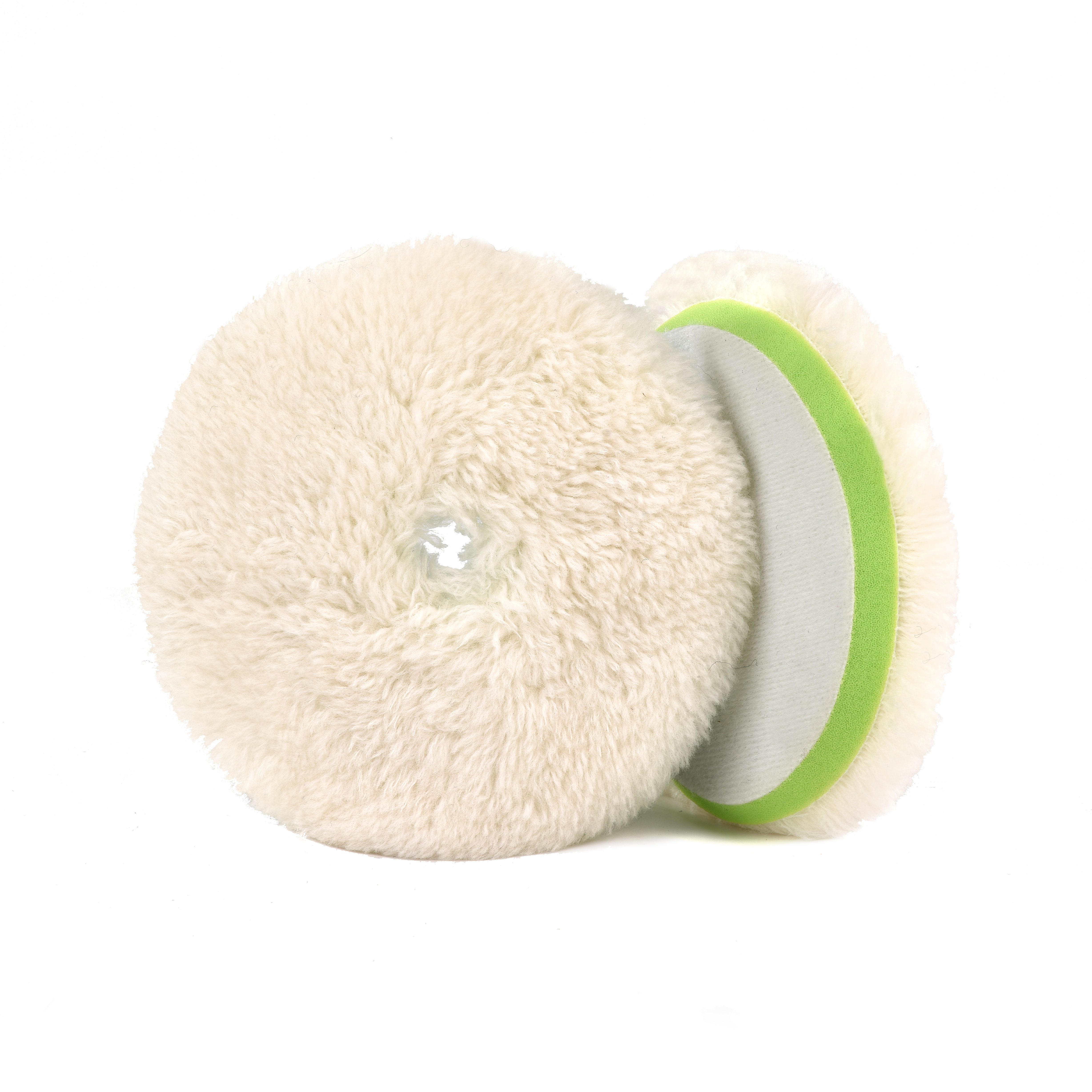
The 5-inch dimension perfectly balances surface area with maneuverability, making it the undisputed industry standard for modern detailing. It fits standard 5-inch backing plates commonly found on modern 15mm and 21mm long-throw orbital polishers. You will find the 5 inch wool polishing pad ideal for navigating modern vehicle panels that feature complex curves, sharp body lines, concave doors, and soft-to-medium clear coats.
Despite its versatility, implementation carries specific operational risks. The smaller surface area means the natural fibers become saturated with spent polishing compound, abraded clear coat residue, and heat much faster than larger alternatives. To maintain optimal cutting efficiency and prevent the fibers from matting down into an ineffective glaze, you must perform frequent spurring with a pad conditioning tool or utilize compressed air blowouts after every single panel section. Failure to clean a 5-inch pad regularly results in a drastic drop in cutting power and an increase in micro-marring.
Stepping up in size allows the operator to cover significantly more surface area per pass. This increased footprint makes the 6 inch wool polishing pad the premier choice for heavy oxidation removal, aggressive gel coat correction, and large-scale industrial polishing. They excel on large, flat panels like commercial truck hoods, van roofs, and expansive marine applications involving boats and recreational vehicles.
The primary implementation risk with this larger dimension involves machine compatibility and rotational drag. These larger pads are highly prone to stalling on DA polishers due to the increased surface friction and heavier rotational weight of the pad itself. To utilize a 6-inch or larger pad effectively, you require a high-torque rotary machine capable of forcing rotation regardless of surface resistance. Attempting to drive a heavy 6-inch wool pad with a standard 8mm throw DA polisher will result in zero pad rotation and zero defect removal.
Modern detailing frequently requires small-diameter wool pads specifically designed for pneumatic mini-polishers and battery-operated micro-polishers. These solution categories address the absolute necessity of correcting intricate areas where standard 5-inch pads simply cannot reach or operate safely. Complex front bumpers, rear louvers, motorcycle fairings, painted window trim, and sensitive piano-black interior components demand precision tools and scaled-down pad dimensions.
Evaluating these micro-dimensions requires a thorough understanding of localized thermal dynamics. Rapid heat buildup is inherent in small-diameter rotary polishing because the machine's energy is focused into a footprint of just one to three inches. The concentrated friction can easily compromise thin paint on panel edges within seconds. To mitigate this risk, operators should utilize short-nap or blended wool for better heat management in tight spaces, keep machine speeds low, and ensure arm movement remains constant.
When executing spot correction with micro-pads, follow these operational guidelines:
Tape off all adjacent plastic trim and rubber seals to prevent accidental friction burns from the edge of the micro-pad.
Apply only one or two pea-sized drops of compound to prevent slinging and pad saturation.
Keep the machine speed under 1200 RPM to manage the intense heat generated by the small surface area.
Never hold the pad stationary on a single spot; maintain continuous, overlapping arm movement.
Dual-action polishers rely entirely on free rotation to execute their orbital stroke and deliver cutting power. Heavy, large-diameter, or excessively long-pile wool pads create massive amounts of drag against the paint surface. This surface drag overcomes the machine's centrifugal force, stopping the pad's rotation entirely. When rotation stops, the cutting process halts, leaving you with only orbital jiggling that fails to remove defects.
To maximize efficiency and maintain the dual-action stroke, stick strictly to a 5-inch or smaller short-nap or knitted wool pad for DA polisher setups. The reduced weight and shorter fibers minimize surface friction, ensuring the machine maintains consistent pad spin even under moderate downward pressure. Knitted wool pads with a foam interface are particularly effective on DA machines because the foam layer absorbs the lateral stress of the orbital movement, keeping the wool face flat against the paint.
Rotary machines operate on a direct-drive mechanism, forcing rotation regardless of surface friction or operator pressure. This mechanical advantage makes them fully capable of driving large 6-inch to 8-inch pads without stalling. The immense torque easily overcomes the drag produced by thick, long-pile wool heavily saturated with cutting compound.
Operators should utilize a larger wool pad for rotary polisher applications when aggressive leveling and rapid sanding mark removal are required on broad surfaces. However, it is imperative to step down to smaller sizes when working near panel edges, raised body lines, or plastic bumpers to prevent the high-speed outer edge from burning through the clear coat. The gyroscopic effect of a large spinning pad on a rotary machine also requires significant physical strength to control, making proper sizing essential for reducing operator fatigue over a long shift.
These pads consist of 100% pure twisted natural wool fibers. They are highly abrasive by design and engineered specifically for maximum defect removal and rapid leveling. You will find them best utilized in larger sizes ranging from 6-inch to 8-inch on rotary polishers. They dominate heavy-duty applications involving severe defect removal, oxidized marine gel coats, and exceptionally hard, high-solid clear coats that resist foam pads. The long pile length allows the pad to absorb massive amounts of clear coat residue without clogging immediately.
Blended pads feature finer, softer synthetic acrylic fibers mixed with natural wool. This construction effectively bridges the gap between heavy compounding and medium polishing. They are highly effective in 5-inch sizes for DA polishers. These blends offer strong defect removal capabilities while leaving a significantly better, glossier finish with far less micro-marring than pure twisted wool. The synthetic fibers also increase the overall durability of the pad, allowing it to withstand repeated washing cycles without shedding excessively.
These represent modern hybrid pad technology. They utilize a dense foam interface positioned directly behind a short, knitted wool face. Ideal for 3-inch to 5-inch sizes, they offer the mechanical cutting power of wool combined with the flexible contouring ability of foam. This structural combination makes them perfect for intricate panel work, transitioning smoothly over complex body lines without losing contact with the paint. The short pile length prevents the pad from absorbing too much compound, keeping the abrasives working on the surface of the paint rather than sinking into the fibers.
Relying on a single pad size severely limits operational efficiency and compromises your results on diverse vehicle fleets. A one-size-fits-all approach forces technicians to use oversized pads on narrow A-pillars, drastically increasing the risk of edge burn, or forces them to use undersized pads on massive truck hoods, wasting valuable labor hours.
Structuring a dedicated shop cart with varied dimensions solves this problem entirely. Equip your detailing stations with 5-inch pads for general DA correction, 3-inch pads for bumpers and intricate trim, and 6-inch pads for rotary heavy lifting. Investing in a comprehensive multi-size system allows technicians to safely and seamlessly transition across different panel geometries without forcing the wrong tool into the wrong space.
The labor time saved by not fighting large pads on small panels, combined with the reduction in rework from accidental edge burns, easily outweighs the initial cost of purchasing multiple backing plates and a comprehensive pad kit. Operational efficiency translates directly to higher shop throughput and better profit margins. A well-stocked detailing cart should include at least four pads of each size to ensure technicians always have a clean, dry pad ready when the current one becomes saturated.
Commercial procurement requires moving far beyond simple unit price analysis. The overall value of a polishing pad is heavily influenced by backing adhesion strength, linting rates out of the package, and long-term washability. Cheaply manufactured pads often suffer from catastrophic velcro delamination after just a few heat cycles or wash routines, rendering them completely useless and driving up replacement costs.
When evaluating bulk suppliers, scrutinize their consistency in pile density across different batches. Ensure they offer matching backing plates designed specifically to support the weight and lateral movement of their pads. Bulk shipping logistics, inventory availability, and reliable lead times also play a crucial role in maintaining your shop's daily operations without interruption.
Implement strict quality control protocols before committing to large commercial orders. Always test a small batch of pads for heat resistance, shedding, and adhesive durability under actual shop conditions. Only after verifying their structural integrity on real test panels should you proceed with a high-volume order to supply your detailing bays.
Audit your current machine inventory to identify specific gaps in your correction capabilities and backing plate sizes.
Measure your existing backing plates with calipers to ensure precise edge-to-edge fitment before ordering new pads.
Procure a multi-size test kit to establish baseline cut rates and finish quality on your most frequently encountered clear coat types.
Standardize your shop protocols to strictly match specific pad sizes with their designated machine types to prevent operator error.
A: No. Running an oversized pad on an undersized backing plate leaves the outer perimeter unsupported. This lack of support causes uneven cutting pressure, reduces defect removal efficiency, and increases the risk of the pad edge catching on trim. It also accelerates velcro delamination due to excessive flexing during operation.
A: For heavy compounding with a rotary polisher, a 6-inch to 8-inch pad made of 100% pure four-ply wool is optimal. The larger diameter generates higher edge speeds, maximizing the aggressive cut rate required to level deep sanding marks and severe oxidation efficiently on broad, flat panels.
A: Dual-action polishers stall when the pad creates too much surface friction or drag, which stops the free rotation mechanism. This typically happens if the pad is too large, too heavy, or features a long pile. Sizing down to a 5-inch or smaller short-nap wool pad resolves this issue by reducing rotational mass.
A: Yes. Pure wool is heavily skewed toward coarse correction and cuts significantly faster than foam. Wool fibers also run cooler, dissipating heat effectively during aggressive compounding. Microfiber pads are generally better suited for medium cut or fine polishing stages rather than heavy, rapid defect removal.
A: Pure wool pads use 100% twisted natural fibers designed for highly abrasive, heavy compounding. Acrylic and wool blended pads incorporate finer, softer synthetic fibers. These blends offer a medium cut, bridging the gap between compounding and polishing, and leave a cleaner finish with less micro-marring on the clear coat.


